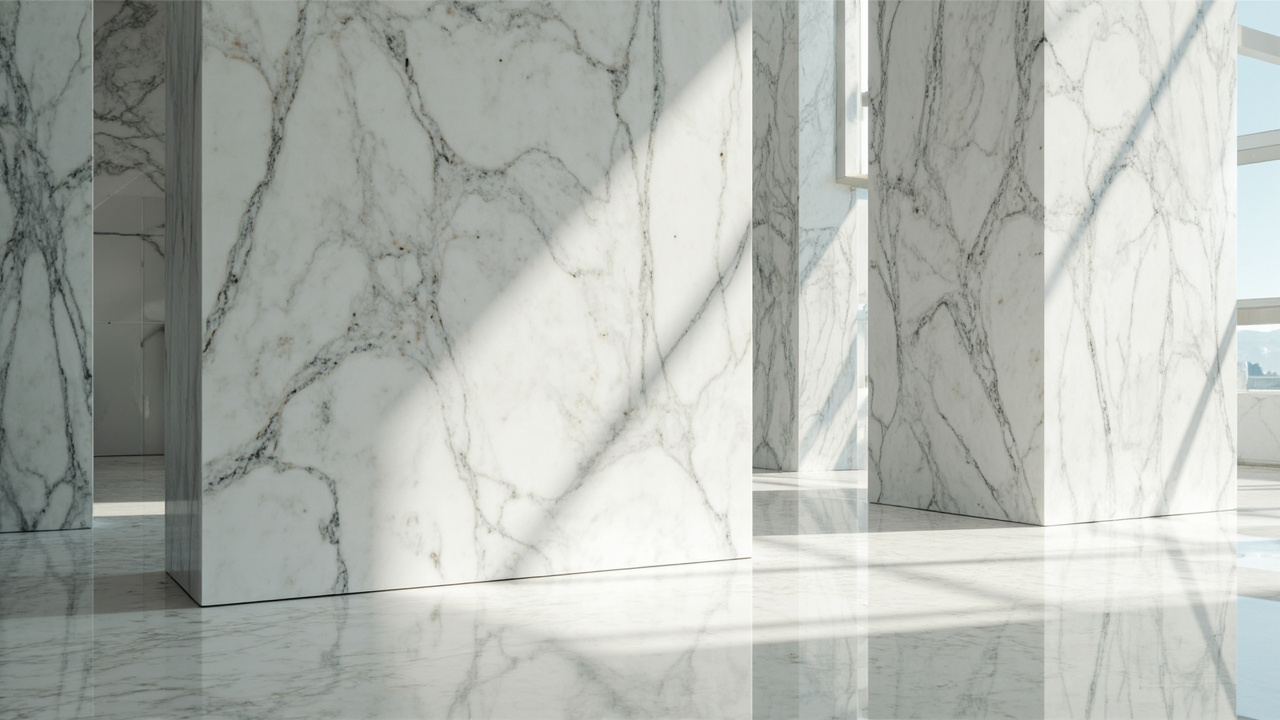
From structural load calculations to vein matching and bookmatching protocols - the technical guide to specifying marble for five-star hotel lobbies.
Why Hotel Lobby Marble Differs from Residential Work
Marble specification for a hotel lobby must account for intensive commercial use, continuous public access, luggage traffic, frequent cleaning and the visual demands of a hospitality environment. Residential projects generally prioritize a limited number of coordinated elements within a private setting. A five-star hotel lobby, by contrast, often combines floors, walls, columns, reception desks and feature surfaces across a large arrival sequence. Every junction, change in plane and transition contributes to the perceived quality of the property.
This distinction is particularly relevant in Saudi Arabia and the UAE, where major hotel developments frequently use expansive pale stones to create bright, monumental interiors. The challenge is not simply finding an attractive marble, but controlling colour, veining, reflection and slab-to-slab variation across hundreds or thousands of square metres. A technically suitable stone can still fail visually if it is selected from photographs rather than from inspected slabs.
- Plan for higher pedestrian, trolley and luggage-wheel loads than in residential interiors.
- Coordinate flooring with entrances, elevators, staircases, fire-rated doors and service routes.
- Assess appearance under both daylight and the hotel’s specified nighttime lighting.
- Establish realistic replacement, maintenance and spare-slab provisions from the outset.
Stone Selection: Geological, Visual and Commercial Considerations
Commercial names such as Calacatta, Statuario and Arabescato describe a visual character, not a guaranteed specification. Within any named material, quarries may operate several beds or production zones with significant differences in background tone, vein structure, clouding and crystalline detail. Stone selection should therefore be based on the actual quarry, extraction area and production batch, with representative slabs reviewed before the material is approved.
Marble is a metamorphic stone whose mineral composition can vary. Some varieties are predominantly calcite and can be etched by acidic substances; others contain dolomite or other minerals with different chemical behaviour. These differences affect cleaning protocols, sealer compatibility, joint treatment and the long-term appearance of the surface.
For large lobby floors, designers should evaluate:
- Background colour range and the degree of natural clouding.
- Vein density, direction, colour and continuity between adjacent slabs.
- Variation in polish, reflection and crystal clarity across the quarry.
- Available slab dimensions, yield and suitability for the intended format.
- Quarry stability, batch consistency, export routes and the supplier’s ability to reserve specific material.
- Compatibility with local fire, structural, accessibility and authority requirements.
Commercial stone names should be treated as reference points rather than sufficient technical descriptions. A complete specification should identify the quarry and bed where possible, define the required finish and thickness, and establish visual tolerances and approval procedures for the actual production run.
Layout, Bookmatching and Visual Continuity
At hotel scale, the defining characteristic is not the individual slab but the relationship between adjacent slabs. Matching vein direction, background tone and density of movement across the installed plane is essential to achieving a coherent
Explore Collection
Explore our extensive range of Italian marble, sourced directly from the quarries of Carrara and processed to the highest international standards.
View Full Catalog -