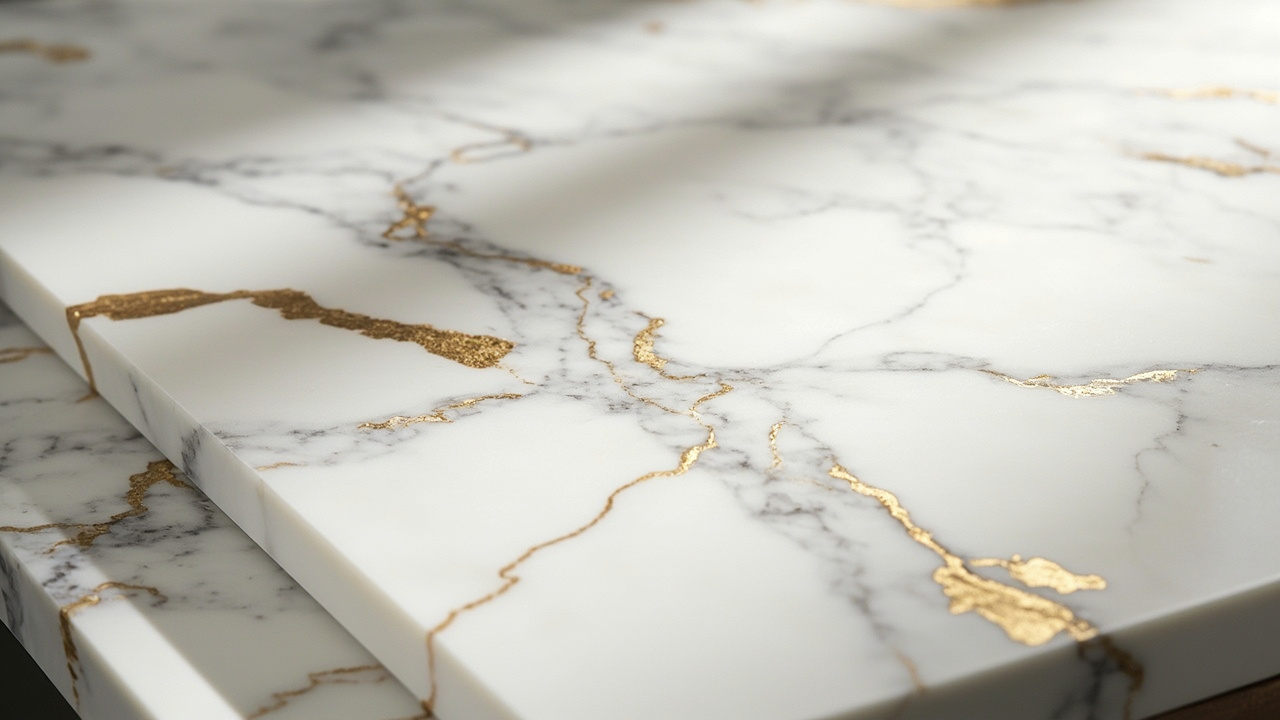
Italian marble brings unmatched elegance to kitchens but requires specific care and sealing protocols. This guide covers selection, installation, and daily maintenance for homeowners considering marble countertops.
Why Italian Marble Is Returning to the Modern Kitchen
After more than a decade dominated by engineered quartz and high-performance porcelains, Italian marble is reappearing in serious residential specifications — not as a nostalgic gesture, but as a deliberate material choice by architects working on premium commissions. The shift is driven by clients who want a surface with geological provenance, visible mineral character, and a tactile quality that no manufactured alternative can convincingly replicate. For professionals specifying a kitchen, this means revisiting a material category that behaves very differently from granite, quartzite, or sintered stone.
The practical consequence is that the assumption set carried over from quartz — uniform performance, factory-controlled color, near-zero maintenance — no longer applies. Marble countertops reward informed specification. They also penalize it.
Material Properties Architects Need to Specify Correctly
Italian marble is a metamorphic rock composed primarily of calcite, which determines nearly every performance characteristic relevant to a working kitchen. It is softer than granite (typically 3–5 on the Mohs scale, compared to 6–7), more porous, and chemically reactive to acids. Lemon juice, red wine, tomato, and certain cleaners will etch the surface — a fact that should be presented to clients not as a defect but as a defining behavior of the material.
- Hardness: Calcite-based; susceptible to scratch and abrasion under heavy cutlery traffic.
- Porosity: Higher than granite; requires periodic sealing with a penetrating impregnator.
- Acid sensitivity: Etching from low-pH substances is a surface reaction, not staining, and can often be polished out.
- Thermal behavior: Excellent heat tolerance, though thermal shock from rapid temperature change is a consideration.
- Veining: Mineral inclusions are aesthetic features but may correspond to structural planes that influence slab orientation and seam placement.
"A marble countertop is not a finished object — it is the beginning of a relationship between a surface and the people who use it. The most successful kitchen marble installations are those where the client understood this from day one."
Selecting the Right Stone: Calacatta, Carrara, and Statuario
Not all white Italian marble behaves the same way, and the price differential between quarry tiers is rarely arbitrary. Architects specifying kitchen marble should understand the distinctions, because they affect both aesthetic outcome and budget conversations with the client.
- Carrara: The most widely available and historically the most affordable of the three. Background tends toward gray-white, with veining that is typically soft, linear, and dispersed. A reliable, workmanlike choice for larger installations where continuity of pattern is less critical.
- Statuario: Quarried in limited volumes, with a brighter white field and more concentrated, often dramatic veining. Frequently selected for bookmatched feature islands or single-slab wall cladding.
- Calacatta: The premium tier. Warmer white background with thick, sculptural veining that can range from gold to taupe to green-gray. Calacatta is typically specified where the slab itself is meant to read as a focal element of the room.
Beyond these, materials such as Breccia Capraia, Travertino Navona, and Arabescato offer denser color palettes for clients seeking something less obviously white. For projects requiring large-format continuity, yard management and lot selection at the quarry level becomes a logistical factor worth discussing early with the fabricator.
Fabrication, Edge Profiles, and Structural Considerations
Marble countertops demand more from fabrication than quartz, in part because the material is less forgiving of unsupported spans and more sensitive to cut quality. Edge profiles should be selected with both aesthetic intent and structural logic in mind: a sharp mitered edge on a deep overhang is a known failure point under thermal or impact stress. For islands exceeding 24 inches of unsupported cantilever, mid-range density stone may require additional substrate support or a steel cradle — a detail that belongs in the construction documents, not resolved in the field.
Seam placement is another specification responsibility that often defaults to the fabricator without architectural input. Veined material reads as continuous only when seams are planned around the slab layout, ideally falling on a vein or at a natural visual break rather than mid-field. For premium kitchen marble installations, full-slab layout drawings should be reviewed and approved before cutting begins.
Care, Maintenance, and the Patina Question
Marble care is the conversation that most often determines whether a client is satisfied five years after installation. The honest framing — that an Italian marble kitchen will develop a soft patina, that localized etching is normal, and that the surface is best understood as evolving rather than preserved — should be introduced during the specification phase, not after the client has called about the first lemon-juice ring.
- Apply a penetrating sealer at installation and reapply on a 12–24 month cycle, depending on use and cleaning products.
- Use pH-neutral cleaners exclusively; avoid vinegar, citrus-based sprays, and abrasive pads.
- Address surface etching with re-polishing or a stone-care professional rather than treating it as permanent damage.
- Specify honed finishes for clients who prefer to minimize the visibility of etching, or polished finishes for those who accept patina as part of the material's character.
Set against the durability narrative of engineered surfaces, this sounds like a liability. In practice, owners who are prepared for it routinely cite the developing patina as a feature rather than a flaw — the visual evidence of a kitchen that is genuinely used.
Specification Guidance for Client Conversations
The most common source of friction between designers and homeowners is not material failure but expectation mismatch. Architects and developers specifying marble countertops benefit from documenting a short, written care and performance brief at the contract stage: what the surface will look like at handover, how it will age, what maintenance the client is agreeing to assume, and which cleaning products are appropriate. This is not warranty language — it is specification language, and it protects the design intent as much as the client relationship.
For projects at the luxury residential tier, where material provenance and craftsmanship are themselves part of the value proposition, Italian marble remains one of the few surfacing choices that holds its narrative integrity over decades. Specified correctly, installed carefully, and maintained with informed expectations, a marble countertop will outlast trends in kitchen design that have already come and gone twice since its installation.
Explore Collection
Explore our extensive range of Italian marble, sourced directly from the quarries of Carrara and processed to the highest international standards.
View Full Catalog -