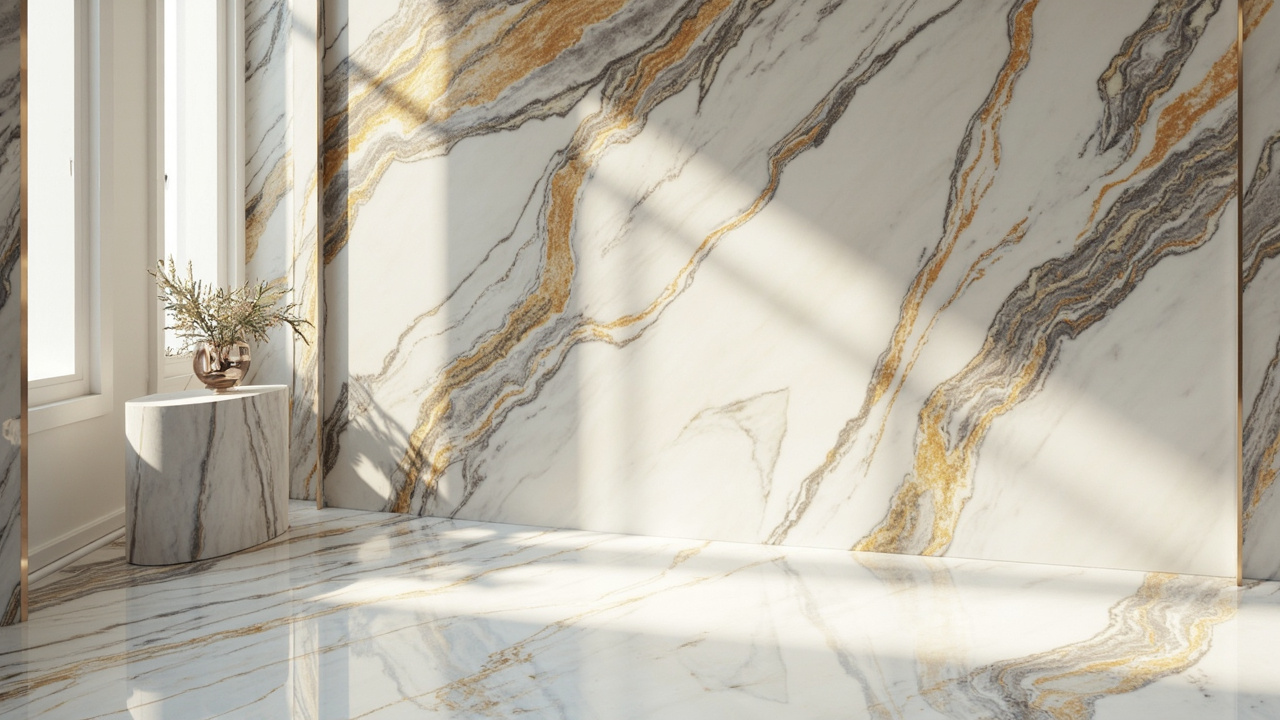
Calacatta Gold commands a premium for good reason - its distinctive warm veining and rare brightness make it the stone of choice for Ritz-Carlton suites, royal palaces, and trophy penthouses worldwide.
A Stone Born in the Apuan Alps
Calacatta Gold is extracted from a narrow vein system within the Apuan Alps, the same geological formation that has supplied marble to European sculpture and architecture for two millennia. Unlike the more widely distributed Carrara CD or the rarer Statuario, Calacatta is defined by a bright, almost luminous white field intersected by warm gold and amber veining — a chromatic signature produced by trace iron oxide and other mineral inclusions deposited during the metamorphic process. This is not a finish applied at the workshop. The colour is integral to the stone, which is why Calacatta Gold cannot be replicated through tinting or resin enhancement alone.
Reading the Veining
For architects engaged in marble selection, the veining structure is the primary criterion of value. Premium blocks display bold, directional veining with clear movement across the slab, while secondary material can appear fragmented or grey-toned. Each block tells a different story, and documenting the quarry face before extraction remains the most reliable method of securing continuity across large surface areas such as hotel lobbies or residential feature walls.
- Field colour: The brightest whites command the highest specification, with cooler undertones increasingly favoured in contemporary luxury interiors.
- Vein density: Architects typically request either bold statement veins or a more restrained, linear movement depending on the scale of the installation.
- Pattern consistency: For bookmatched feature walls, sequential numbering of slabs is essential during slab selection at the warehouse.
"Fewer than fifty blocks of true Calacatta Gold are quarried in a typical year — a figure that shapes both pricing and the patience required for serious specification."
Specification Considerations
Architect specification for Calacatta Gold should account for several technical realities before drawings are finalised. Slabs are typically produced in standard thicknesses of 20mm and 30mm, though bespoke formats are available for large-format cladding. The stone accepts a high polish but is equally expressive in honed and leathered finishes, the latter revealing the geological layering in a way that suits tactile, residential environments. Coefficient of thermal expansion, absorption rates, and flexural strength should be reviewed against the intended application — particularly for exterior cladding or installations near heat sources.
Applications in Luxury Interiors
The material's visual weight makes it a natural anchor for spaces designed around a single sculptural gesture. Across recent international commissions, Calacatta Gold has been specified for bathroom cladding in flagship hospitality projects, monolithic kitchen islands in private residences, fireplace surrounds, and full-height lobby walls. Its warm tonal range pairs effectively with brushed brass, walnut joinery, and the cooler greys of complementary stones such as Bardiglio or Grey Carnico, allowing designers to build layered material palettes without losing cohesion.
- Bathroom environments, where the polished surface amplifies both natural and artificial light.
- Statement kitchen islands, often mitred or bookmatched to maximise vein movement.
- Reception desks and hospitality lobbies requiring a singular focal element.
- Custom furniture and lighting objects for ultra-high-end residential commissions.
Working With the Material
Fabrication requires experience with hard, dense metamorphic stone. Resin treatment is standard for the small natural fissures typical of Calacatta, and reputable suppliers apply this at the quarry rather than at point of sale. CNC cutting, waterjet profiling, and hand-finishing all yield excellent results when performed by fabricators familiar with the stone's behaviour. On site, installers should receive slabs well in advance of placement to allow for acclimatisation, and the initial seal should be specified according to the final use — a kitchen island requires different protection than a decorative wall.
Sourcing and Selection
For projects where material continuity across multiple surfaces is essential, direct consultation at the quarry or warehouse is advisable. Selecting blocks in person allows the specifier to evaluate vein direction, tonal range, and block yield before cutting begins. At Apuana Carrara, we work directly with architects and developers to align block selection with project timelines — coordinating extraction, cutting sequences, and delivery so that the stone arriving on site reflects the intended design intent rather than what remains available. In a material as finite as Calacatta Gold, that early involvement is often what separates a successful installation from a compromised one.
Explore Collection
Explore our extensive range of Italian marble, sourced directly from the quarries of Carrara and processed to the highest international standards.
View Full Catalog -